Skip to content

Practical Information
Invasive
Restore hair density in areas affected by hair loss.
4 to 8 hours
Local anesthesia
From the 4th month onwards (initially, there is a shedding phase lasting approximately 3 months).
Permanent, provided that appropriate ongoing hair care is maintained (maintenance treatments for hair loss are recommended).
What is a Hair Transplant?
Hair transplantation (for both men and women) is a type of microsurgical procedure in which hair follicles are removed from areas where hair is abundant (the donor area) and implanted into areas with hair loss or thinning (the recipient area).
Hair transplantation is a procedure with over 50 years of history, during which several techniques have been developed and refined over time.
The most widely used technique in hair transplantation is FUE (Follicular Unit Extraction). This is a minimally invasive, virtually painless procedure that allows for fast recovery and excellent, natural-looking results, as it does not leave linear or visible scars. As a result, it enables patients to wear their hair very short in the future.
What is Hair Transplant used for?
Hair transplant allows an increase in hair density in areas affected by thinning or alopecia and, when indicated, the reconstruction of the hairline, restoring a more harmonious and natural facial frame.
Through the strategic implantation of follicular units (for example, in the frontal area, temples, and/or crown), it is possible to fill in more visible areas, improve overall coverage, and achieve progressive and long-lasting results tailored to the pattern of hair loss, hair type, and individual aesthetic goals.
How does Hair Transplant work?
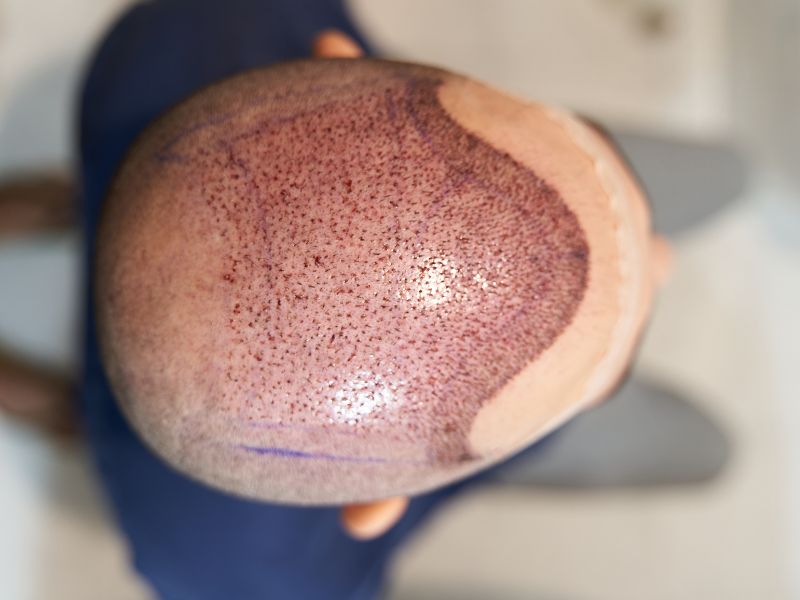
With FUE technology, follicular units are transplanted individually, exactly as they naturally grow on the scalp, from the donor area to the bald (recipient) area.
Each follicular unit contains, on average, two hairs, although it may include only one hair or, in some cases, two, three, or four hairs.
Who is Hair Transplant indicated for?
Hair transplant is indicated for people with stabilised hair loss who are seeking a definitive solution to improve hair density or correct areas of alopecia, following an individual medical assessment.
- Male Pattern Baldness (Androgenetic Alopecia): This is the most common indication. Men with typical hair loss patterns, such as a receding hairline and thinning at the crown, are ideal candidates.
- Female Pattern Hair Loss (Female Androgenetic Alopecia): Women with reduced hair density but with a dense and healthy donor area are good candidates.
- Hair Restoration after Injury or Surgery: Individuals who have lost hair due to scars from accidents, surgeries, or burns may benefit from a hair transplant.
- Cicatricial Alopecia: Certain forms of cicatricial alopecia, in which hair loss is permanent, may be treated with hair transplantation.
- Correction of Previous Hair Transplants: Patients who are dissatisfied with the results of previous hair transplants may undergo a corrective procedure, depending on the condition of their donor area.
Recovery and Aftercare
During the first 3 days after a hair transplant, the following precautions should be observed:
The hair must not be washed and should only be kept hydrated with saline solution;
The transplanted area should remain uncovered, avoiding the use of scarves or hats;
Sun exposure should be avoided as much as possible;
After a hair transplant, it is important to take specific precautions when sleeping in order to protect the newly transplanted grafts and promote proper healing (see the guidelines in the “Frequently Asked Questions” section below).
Possible side effects of a hair transplant may include:
Swelling of the head and around the eyes due to the drainage of the anaesthetic. This may occur if post-procedure care is not properly followed;
Redness of the scalp, which usually disappears after about one week;
Healing of the follicular pores may lead to the formation of small scabs, which typically disappear after one week with careful washing of the scalp.
Expected Results
The expected results of a hair transplant include the growth of new hair in areas affected by hair loss, providing a fuller and more natural appearance. This growth typically becomes noticeable between 3 and 4 months after the procedure, as the transplanted follicles require time to adapt and enter the growth cycle. Hair density continues to improve progressively, with final results usually becoming evident 9 to 12 months after the transplant.
The transplanted hair is permanent and continues to grow like the rest of the hair, as the follicles are harvested from areas resistant to hair loss, such as the back of the scalp. However, it is important to note that although the transplanted hair is long-lasting, hair loss may continue in other areas, particularly if alopecia is progressive. In some cases, additional sessions or complementary hair treatments may be recommended to maintain overall density and optimise the final outcome.
Although the final result depends on each patient’s individual response, patients generally report a significant improvement in hair density, a more rejuvenated appearance, and increased self-confidence following the procedure.
Frequently Asked Questions
How long does a hair transplant take?
Between 4 and 8 hours, depending on the size of the area to be treated, and performed under local anaesthesia. When a large area requires coverage, two procedures may be recommended to achieve greater density.
Is it necessary to shave the hair to undergo a hair transplant?
At Living Clinic, full shaving is not mandatory. However, shaving the hair makes the procedure faster and technically easier.
The option of not shaving is particularly advantageous for women who prefer to keep their hair length.
What are the donor and recipient areas in a hair transplant?
The donor area is usually located in the occipital region (back of the head) and the temporal regions (behind the ears).
The recipient area is typically the frontal area, top of the scalp, or crown, which are the most commonly affected areas in hair loss.
Does this type of microsurgery leave visible marks or scars?
With the FUE technique, hair transplantation does not leave any visible scars.
Are follow-up appointments scheduled after the transplant?
Yes. A follow-up visit is scheduled immediately after the procedure, including the first scalp wash. This is followed by four medical follow-up appointments over the course of one year.
Can the transplanted hair fall out again?
It is normal for transplanted hair to shed about one month after the procedure. This is followed by a new hair growth cycle, during which new hair begins to grow.
Because transplanted follicles are taken from a safe donor area, they tend to remain strong and permanent for life.
Hair Transplant or Hair Implant?
Many patients confuse hair transplantation with hair implantation due to a lack of understanding of the procedures. Hair implants involve the placement of artificial hair fibres, which do not grow.
If a synthetic hair falls out or is removed, it must be replaced. There is also a risk of rejection or scalp infection.
At our clinic, we do not perform hair implants. The safest procedure with long-lasting results is hair transplantation.
How should you sleep after a hair transplant?
After a hair transplant, certain precautions are important to protect the grafts and support healing:
-
Keep your head elevated: For the first few days, sleep with your head elevated at a 45-degree angle to reduce swelling. Extra pillows or a reclining chair can help.
-
Avoid direct contact: Prevent the transplanted area from touching the pillow. A travel neck pillow or a specialised pillow can reduce pressure on the scalp.
-
Sleep on your back: Sleeping on your back is recommended during the first days. Avoid sleeping on your side or stomach.
-
Be careful when getting up: Stand up slowly, especially in the first mornings after the procedure, as mild dizziness or sensitivity may occur.
These are general guidelines. Your doctor will provide detailed and personalised post-procedure instructions.
Are there less invasive treatments for hair loss?
Yes. Learn more about PRP Hair Treatment and Hair Mesotherapy, available at Living Clinic in Porto.
Specialists
What is the price of a Hair Transplant?
The price of an FUE hair transplant varies according to the complexity of the procedure and the size of the area to be treated. Schedule a consultation to receive a personalised assessment, obtain an exact quote for your specific case, and clarify any questions you may have.
What our clients say about us
“I couldn’t thank Dr. Paola (dermatologist) enough for her care and kindness. She explained the procedure (CO2 laser) to me, the post-procedure care, and answered my questions. I had already had the same procedure at another clinic, but it didn’t compare to the treatment I received with this doctor…she was very dedicated and friendly. And […]
“I really enjoyed my experience at this clinic. The staff is conscientious and professional. The results were excellent and they give us a realistic view of what’s expected so we can manage expectations. I’m really satisfied!”
“Dr. Francisco Martins De Carvalho doesn’t overlook the smallest detail. He seeks perfection and finds it. A unique and sublime talent. I woke up with the body of a teenager (I’m 41). Thank you for making me smile.”
“My husband and I were seen by Dr. Paola, who was wonderful and very attentive to every detail. I highly recommend her.”
“I’ve been coming here for a while now and love my experience. The people are accommodating friendly and very professional. I’m happy with the results and it has lived up to my expectations! I shall continue to visit this clinic and I highly recommend it.”
“Super professional and top-quality team. I saw results after the first session.”
“One of the best surgeons, I’m so grateful for the excellent work he did with me! A perfectionist!! I couldn’t be happier with the results! Thank you, Dr. Francisco Carvalho!”
LOCATION
Where to get Hair Transplant in Porto?
You can undergo your Hair Transplant at Living Clinic, located at Av. da Boavista 117, 6th floor, Room 607, 4050-115 Porto.
Book a consultation to receive our recommendation for your specific case and clarify all your questions.