Skip to content

Practical Information
Plastic Surgery.
- Reduce breast size;
- Lift the areola and nipple (correct sagging breasts);
- Correction of breast asymmetry.
2 to 3 hours.
General anesthesia.
Outpatient care or a 1-day hospital stay, depending on the surgeon’s recommendation.
2 to 3 weeks.
What is Breast Reduction?
Breast reduction surgery, also known as reduction mammaplasty or breast reduction, is a procedure designed to decrease the volume and weight of the breasts. It helps relieve neck and back pain, reduce the marks caused by bra straps, and eliminate skin irritation or inflammation in the inframammary fold.
It is important to note that breast reduction and mastopexy are not the same. While reduction mammaplasty is a type of mammaplasty primarily aimed at reducing breast size, mastopexy focuses on lifting and reshaping the breasts.

How is it performed?
Breast reduction surgery can be performed using different techniques. In the vertical technique, the breast is left with a scar around the areola and another vertical scar extending from the areola to the inframammary fold. However, when a larger reduction is required, an additional incision along the inframammary fold is necessary – known as the inverted-T technique.
The procedure is performed under general anesthesia and lasts an average of 2 to 3 hours. It can be carried out on an outpatient or inpatient basis, according to the surgeon’s recommendation.
Who is this surgery for?
Breast reduction surgery is suitable for any woman who wishes to reduce the size of her breasts, whether for aesthetic reasons or health and well-being – such as back or neck pain, postural problems, skin irritation beneath the breast due to friction, or deep marks from bra straps, among others.
This procedure can also correct breast asymmetry and lift the areola and nipple, helping to eliminate the appearance of sagging breasts.
Expected Results
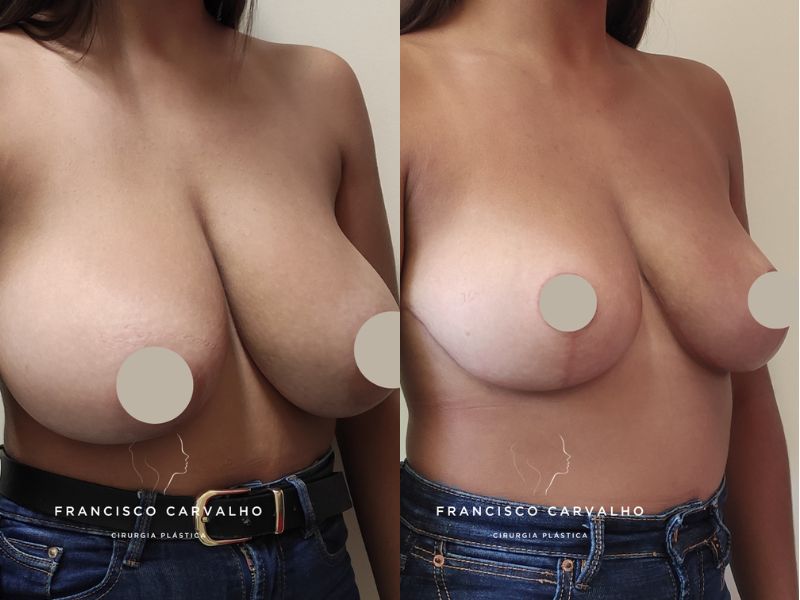
The final result of breast reduction surgery becomes definitive after approximately four months. The procedure is expected to achieve a breast reduction that is balanced both aesthetically and functionally. In other words, after undergoing this surgery, the patient should no longer experience discomfort such as back pain.
Breast reduction also helps achieve greater breast symmetry and a higher position of the areola and nipple.
Breast Reduction Post-Surgery and Recovery
Generally, 24 to 48 hours after discharge, the patient should return to the clinic for drain removal, following daily monitoring by the surgeon. Based on the surgeon’s recommendation, the first lymphatic drainage session may also be performed at this time.
During the postoperative period, it is essential to wear a compression bra, both day and night, for 6 to 8 weeks. Lymphatic drainage sessions can be performed twice a week.
It is normal to feel some discomfort when performing certain movements, such as lifting the arms. However, this type of pain is usually tolerable and can be relieved with pain medication.
All scar care instructions will be thoroughly explained by the surgeon.
The recovery period and time away from activities will depend on the patient’s occupation and level of physical activity.
What is the scar like after Breast Reduction?
The type of scar depends on the technique used.
In the vertical technique, the breast is left with a scar around the areola and another vertical scar extending from the areola to the inframammary fold. However, in cases of larger reductions, it is also necessary to make an incision along the inframammary fold – known as the inverted-T technique.
The length of the scar along the fold depends on the breast base width, the axillary extension, and the distance between the breasts.
In addition to lymphatic drainage performed by a physiotherapist, scars require specific care to help them become less noticeable. It is recommended to use hydrating and regenerative creams, silicone sheets, and elastic compression (such as the support from the bra’s underband).
If these measures are followed correctly, the scars generally stabilize after about six months and become almost imperceptible one year after surgery.
Frequently Asked Questions
What type of anesthesia is used?
Breast reduction surgery is performed under general anesthesia and typically lasts up to 2 hours.
How long is the hospital stay?
The procedure can be done on an outpatient or inpatient basis, depending on the surgeon’s recommendation.
Is the postoperative period painful?
No. However, it is normal to feel some discomfort when performing certain movements, such as lifting the arms. This type of pain is generally tolerable and can be relieved with pain medication.
From what age is breast reduction recommended?
Once breast development is complete, usually around 18 years of age, except in cases of severe virginal breast hypertrophy, where reduction may be performed earlier.
Can I lose nipple sensitivity after surgery?
There may be a slight temporary change in sensitivity immediately after surgery, which typically returns within about three weeks. In rare cases, permanent loss of nipple sensitivity can occur.
If the breasts have different shapes or sizes, can this be corrected during surgery?
Yes. This is one of the main goals of the procedure – to reduce and achieve breast symmetry.
Can the breasts grow again after surgery?
It is possible that, years later, the breasts may increase in size or lose some firmness due to factors such as natural aging, pregnancy, or weight gain.
What are the risks of breast reduction surgery?
Breast reduction is considered a safe surgical procedure, although not entirely free of risks. In rare cases, the following complications may occur:
- Infections
- Decreased nipple sensitivity
- Unsightly scars
- Asymmetry
Will I be able to breastfeed after breast reduction surgery?
The answer varies from case to case. In situations where a significant reduction is performed, the ability to breastfeed may be affected, depending on the amount of glandular tissue removed and whether the milk ducts are disrupted, which can interfere with milk production and flow. However, the surgical technique can be adapted to help preserve the ability to breastfeed, if that is the patient’s wish.
What are the contraindications for breast reduction surgery?
Breast reduction should not be performed on women who are overweight or under 18 years old, as the breasts may still be developing.
Women with certain health conditions – such as serious heart disease, poorly controlled diabetes, or bleeding disorders – may be at higher risk during surgery.
Smoking can also significantly increase the risk of complications, including poor wound healing and infections, so patients are strongly advised to stop smoking several weeks before and after surgery.
Plastic Surgeon
[Medical License #53318]
Dr. Francisco Martins de Carvalho is a specialist in Plastic, Reconstructive and Aesthetic Surgery. He completed his degree in Medicine at the School of Medicine of the University of Oporto and the Internship in Specific Training in Plastic, Reconstructive and Aesthetic Surgery took place at Hospital de São José (Lisbon) and Hospital de São João (Oporto).
Dr. Francisco Martins de Carvalho performed several internships, namely on Oncology Surgery of the Head and Neck at the Portuguese Institute of Oncology – Oporto and a fellowship of Hand Surgery, organized by the Portuguese Society of Hand Surgery. He also performed international internships in Aesthetic Surgery, Breast Reconstruction and Lymphedema at the Clinic Planas – Barcelona, at the University Hospital of Brussels and at the Villa Sant’Apollonia Clinic – Bergamo, having contacted with references in Plastic Surgery such as Dr. Jaume Masià, Dr. Moustapha Hamdi and Dr. Enrico Robotti.
Currently, he is also a plastic surgeon at the Hospital de São João – Oporto, and a Invited Lecturer at the School of Medicine of the University of Oporto.
In the field of cosmetic surgery, he has a special interest in facial cosmetic surgery, breast cosmetic surgery, body contouring surgery and vaginal cosmetic surgery.
What is the Price of Breast Reduction?
At Living Clinic, the price of breast reduction surgery ranges from €3750 to €4750.
The final cost of the procedure may vary depending on several factors, so a personalized assessment is required.
Schedule a consultation to receive a detailed quote and clarify all your questions.
Financing options: At Living Clinic, we want to ensure that all patients have access to the treatment they desire. That is why we provide financing options (interest-free financing for up to 12 months), allowing you to undergo your surgery in a more affordable way, without compromising the quality of the procedure and care.
Plastic Surgery Testimonials
“Dr. Francisco Martins De Carvalho doesn’t forget the smallest detail. He seeks perfection and finds it. A unique and sublime talent. I woke up with the body of a teenager (I’m 41). Thank you for making me smile.”
“Very attentive doctor, very helpful and friendly receptionist. Welcoming and pleasant environment.”
“I had a gynocomastia surgery about two weeks ago, performed by Dr. Carvalho. The surgery went exactly as he outlined during the consultation. The process was very smooth and painless. Even though it’s only been two weeks, it feels like I never had surgery, and the result is truly flawless. Dr. Carvalho provided very detailed […]
“One of the best surgeons, I’m so grateful for the excellent work he did with me! A perfectionist!! I couldn’t be happier with the results! Thank you, Dr. Francisco Carvalho!”
“Dr. Francisco Carvalho is undoubtedly the best plastic surgeon with a very promising future ahead. His dedication, responsibility, professionalism, concern for patients, sensitivity, and humility are second to none. I highly recommend him. Thank you, Dr. Francisco, and the entire team for everything, but especially Dr. Francisco Carvalho. I recommend this plastic surgeon to anyone […]
location
Where to have Breast Reduction in Porto?
Have your Breast Reduction at Living Clinic with maximum safety and natural results! We are located at Av. da Boavista 117 6th floor, Room 607, 4050-115 Porto, Portugal.
Schedule a consultation with the plastic surgeon to hear his recommendation for your specific case and clarify all your questions.