Skip to content

Practical Information
Plastic Surgery
-
Reduce wrinkles, skin laxity and/or localised facial fat;
-
Improve facial contour.
4 to 6 hours
General Anesthesia
1 day
3 to 4 weeks
What is a Facelift (Facial Lift)?
A facelift, also known as a facial lift or rhytidectomy, is a plastic surgery procedure that enables comprehensive rejuvenation of the face and neck. This is achieved by removing excess skin and repositioning the deeper tissue layers.
The aim is to address the signs of facial ageing. People who choose to undergo a facelift have often already tried basic aesthetic treatments, such as botulinum toxin (Botox) or hyaluronic acid fillers, but these are no longer sufficient to mask the natural ageing of the skin and they seek longer-lasting results.
It is often combined with fat grafting, allowing restoration of lost volume, particularly in the cheek area.
Signs of facial ageing are progressive and naturally visible, typically beginning around the eyes and gradually descending until they reach the neck. For this reason, the surgical approach varies depending on the areas being treated, the placement and extent of the incisions, and the use of complementary techniques (eyelid surgery, malar augmentation, etc.).

How is it performed?
A facelift is performed as a single procedure (under general anaesthesia), following a thorough pre-operative assessment in which the patient’s expectations and the different surgical approaches are discussed. It typically lasts between 4 and 6 hours and requires a 1-day hospital stay.
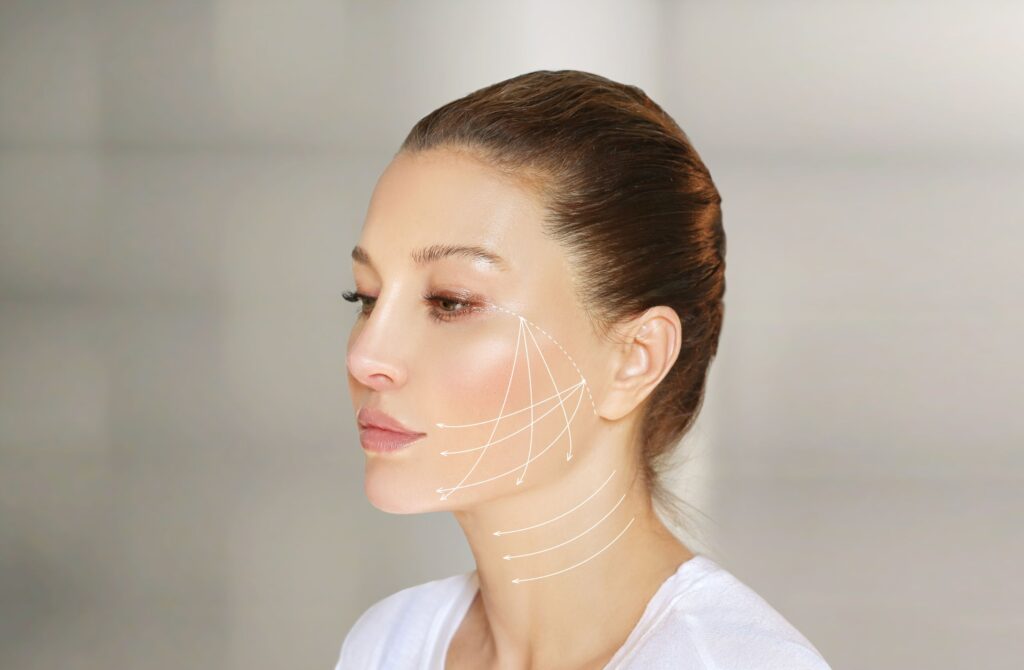
The surgical technique essentially involves repositioning the muscular layers, skin and fat, removing excess skin through an incision that is discreetly concealed.
In addition to the skin, the surgery focuses on the underlying muscles and fat, which helps achieve more natural and longer-lasting results over the medium and long term.
The wounds are closed with sutures, and small silicone drains are placed beneath the skin to prevent any build-up of fluid or blood.
Who is this surgery for?
A facelift is a surgical procedure primarily indicated for people who wish to improve visible signs of ageing in the face and neck. It is often recommended for individuals who present with:
- Facial skin laxity;
- Wrinkles under the eyes;
- Wrinkles along the nose extending to the corners of the mouth (nasolabial folds);
- Changes in facial fat distribution;
- Loss of muscular firmness in the lower face;
- Loose skin and excess fat deposits in the chin and jawline area;
- Neck laxity.
Expected Results
The longevity of facelift results can vary significantly from person to person, depending on several factors. On average, results may last around 10 years, but this timeframe may be shorter or longer depending on each individual’s response, skin quality, age, lifestyle, and other factors.
The surgical effect of a facelift acts as a “brake”, slowing the natural ageing process of the face, but the result is not permanent.
At the end of the recovery period, a more rejuvenated appearance is expected, with firmer skin and fewer wrinkles.
Facelift Post-Surgery and Recovery
The patient leaves the operating theatre with the head wrapped in a padded dressing and with a drainage system in place. This dressing is removed the following day; the face and hair are washed and the patient is then discharged.
In the following 48 hours, the drains are removed after the first facial and cervical lymphatic drainage session.
The post-operative period is not usually painful. Any discomfort is well controlled with standard analgesics.
Eyelid and facial sutures are removed after 5–7 days, facial stitches at 8 days, and the sutures near the hairline at 10–15 days.
After a facelift, the face may appear more or less swollen depending on the extent of the surgery and each patient’s individual characteristics. Swelling can be present for the first 15 days. During this period, several drainage sessions are required, and sun exposure and physical exercise should be avoided for 3 months.
Light work can usually be resumed after 3–4 weeks.
What is the scar like after Facelift?
The scar around the ear is easily concealed and is generally barely noticeable after a few months (approximately 3 to 6 months).
Typically, the incision begins in the temporal region within the hairline, extends along the natural creases of the ear, continues around the earlobe, passes behind the ear and then re-enters the hairline, extending down towards the neck.
The plastic surgeon will use techniques to minimise scarring and make scars as discreet as possible. In addition, incisions are usually made in areas where they can be easily hidden by the hair or by the natural contours of the face and ears.
You should follow your surgeon’s post-operative care instructions to ensure proper healing. This may include avoiding sun exposure, not smoking, and using recommended scar creams or gels.
The final appearance of scars also depends on individual factors such as genetics, age, skin type and the body’s overall healing capacity.
In some cases, additional treatments may be recommended to improve the appearance of scars, such as fractional CO₂ laser.
Frequently Asked Questions
What are the benefits of a Facelift?
A facelift will improve the overall appearance of the face and neck, giving a more rejuvenated look, including:
- Reduced skin laxity;
- Reduction of deep wrinkles;
- Improved facial contour;
- Reduced fat accumulation in specific areas of the face.
In addition to these visible benefits, patients often report a significant increase in self-esteem and long-lasting results.
What type of anesthesia is used?
A facelift is performed under general anesthesia.
How long does the procedure take? What is the length of hospital stay?
A facelift typically lasts between 4 and 6 hours and requires a 1-day hospital stay.
What is the pre-operative period like (before surgery)?
During the pre-operative period, medical tests are requested to identify any potential abnormalities that could contraindicate surgery. All steps of the procedure will be explained.
The patient’s facial structure and skin quality are assessed, and it is common to perform a peel or another facial treatment before surgery.
It is also important for patients who smoke to refrain from smoking before surgery and for two weeks afterwards, as smoking can negatively affect healing.
What is the ideal age for a facelift?
There is no ideal age. The appropriate timing is when the patient and surgeon consider it suitable.
How long do the results last?
The longevity of facelift results can vary significantly from person to person, depending on several factors. On average, results may last around 10 years, but this period may be shorter or longer depending on individual response, skin quality, age, lifestyle, and other factors.
The surgical effect of a facelift acts as a “brake”, slowing the natural ageing process of the face, but the result is not permanent.
Can a facelift change facial expression?
It cannot and it should not. However, it is natural to feel that your face looks unusual or different in the mirror during the first few days, but this gradually returns to normal.
The goal of a facelift is to achieve the most natural-looking results possible.
When can I return to work?
After 3 to 4 weeks, you can usually resume professional and social activities, as surgical marks will be imperceptible.
As the main purpose of a facelift is to achieve natural results, the surgery itself should not be noticeable – only a more refreshed, rejuvenated appearance.
Plastic Surgeon
[Medical License #53318]
Dr. Francisco Martins de Carvalho is a specialist in Plastic, Reconstructive and Aesthetic Surgery. He completed his degree in Medicine at the School of Medicine of the University of Oporto and the Internship in Specific Training in Plastic, Reconstructive and Aesthetic Surgery took place at Hospital de São José (Lisbon) and Hospital de São João (Oporto).
Dr. Francisco Martins de Carvalho performed several internships, namely on Oncology Surgery of the Head and Neck at the Portuguese Institute of Oncology – Oporto and a fellowship of Hand Surgery, organized by the Portuguese Society of Hand Surgery. He also performed international internships in Aesthetic Surgery, Breast Reconstruction and Lymphedema at the Clinic Planas – Barcelona, at the University Hospital of Brussels and at the Villa Sant’Apollonia Clinic – Bergamo, having contacted with references in Plastic Surgery such as Dr. Jaume Masià, Dr. Moustapha Hamdi and Dr. Enrico Robotti.
Currently, he is also a plastic surgeon at the Hospital de São João – Oporto, and a Invited Lecturer at the School of Medicine of the University of Oporto.
In the field of cosmetic surgery, he has a special interest in facial cosmetic surgery, breast cosmetic surgery, body contouring surgery and vaginal cosmetic surgery.
What is the Price of Facelift?
The cost of a facelift varies depending on several factors, so an individual assessment is required. Schedule a consultation to receive a personalised quote and have all your questions answered.
Financing options: At Living Clinic, we want to ensure that all patients have access to the treatment they desire. That is why we provide financing options (interest-free financing for up to 12 months), allowing you to undergo your surgery in a more affordable way, without compromising the quality of the procedure and care.
Plastic Surgery Testimonials
“Dr. Francisco Martins De Carvalho doesn’t forget the smallest detail. He seeks perfection and finds it. A unique and sublime talent. I woke up with the body of a teenager (I’m 41). Thank you for making me smile.”
“Very attentive doctor, very helpful and friendly receptionist. Welcoming and pleasant environment.”
“I had a gynocomastia surgery about two weeks ago, performed by Dr. Carvalho. The surgery went exactly as he outlined during the consultation. The process was very smooth and painless. Even though it’s only been two weeks, it feels like I never had surgery, and the result is truly flawless. Dr. Carvalho provided very detailed […]
“One of the best surgeons, I’m so grateful for the excellent work he did with me! A perfectionist!! I couldn’t be happier with the results! Thank you, Dr. Francisco Carvalho!”
“Dr. Francisco Carvalho is undoubtedly the best plastic surgeon with a very promising future ahead. His dedication, responsibility, professionalism, concern for patients, sensitivity, and humility are second to none. I highly recommend him. Thank you, Dr. Francisco, and the entire team for everything, but especially Dr. Francisco Carvalho. I recommend this plastic surgeon to anyone […]
LOCATION
Where to have Facelift in Porto?
Have your Facelift at Living Clinic with maximum safety and natural results! We are located at Av. da Boavista 117 6th floor, Room 607, 4050-115 Porto, Portugal.
Schedule a consultation with the plastic surgeon to hear his recommendation for your specific case and clarify all your questions.